
Dancing faces, quivering lips
On emoting, lip syncing and the slowly disappearing world of cinematic expressions

I was in the middle of a turn when Betsy teacher, our designated dance mentor for the annual day performance, called out my name. In the school where I studied (the Gulf as they call it), being chosen for an annual day performance, for a Hindi song, was a coup. If we struggled to make the coveted list, some of us would perform other dances, unimaginatively called Marathi dance, Bengali dance; to feel the stage. I had once suffered this fate. But not in the year 1998. No, that was my year. I was chosen for a Hindi song from a movie called Dil Toh Pagal Hai.
Back then, film songs travelled slowly to the Gulf. Even when a song had become a superhit in India, many of us would find it much later, through friends or dance teachers who had made their annual trip back home. Moreover, in a household like mine, where Malayalam cinema shaped our viewing habits, Shah Rukh Khan and his oeuvre made a very late entrance. Thus, when I performed Chak Dhoom Dhoom that year, it existed for me only as a Hindi song—without the weight of Shah Rukh or Madhuri’s charisma. Despite the familiar vocals of Udit Narayan and Lata Mangeshkar, the song felt strangely bare, devoid of the skin that visuals would have given it. Yet, even without images to hold on to, I could still imagine myself as the beloved object of affection. In this empty space where the lover was asking: Koi ladka hei..jab woh gaatha hei, it was I who would wait for the response; not Madhuri. Perhaps it was something in the lyrics themselves, or the texture in the singers’ voices, or perhaps it helped that my crush was dancing a row behind mine; even without visuals, the music made longing possible.
“Look at her. Look at her expressions. Deepti, do it once again.”
Twenty-something faces turned towards me. I was nervous about being called out, doing something that I had only done in the privacy of our shared bathroom at home. But I hoped being singled out could be an indicator of praise. My last chance to impress my crush, who was waiting impatiently for me to do whatever Betsy teacher had seen me doing.
“Baadal jhuke jhuke se hain
The clouds hang low in the sky
Raste ruke ruke se hain
The paths have stopped themselves
Kya teri marzi hei meghaaa
What is your wish moon-cloud?
Ghar humko jaaane na deeeega
That you won’t let us go home”
I mouthed the lyrics with ease and replicated the steps, singing under my breath as I did so, letting my voice melt into Mangeshkar’s. A smile spread across my face as I sang baadal, and at jhuke, I too sighed gently, letting my head fall with my hands. Even with limited proficiency in Hindi, I absorbed the meaning of the words as I listened to the song repeatedly on tape, while practicing at home. At ghar humko jaane na deeega, my expression of longing transformed into mischief when I drew out the deega with a playful wink and a gentle wagging of my index finger.
At the end of it, Betsy teacher moved me a row forward and asked everyone to follow me as I danced. “With life”, she said, “not like robots”.
That moment was my first introduction to the power of “expressions,” as Betsy teacher called it, and to the art of lip-syncing. Even when I later learned bhavam and rasas as a student of Bharatanatyam, I continued to fall back on the universe of “expressions.” In film songs, I encountered what Riddhi Dastidar describes as the dream logic. A world where the camera is exactly where you want it to be, zooming in when your eyes widen as you replicate Madhuri’s brow tricks, and zooming out when you prepare to swing into an impossible movement. Can’t circle your feet as Madhuri did in “resham ka lehenga mera” for Choli ke peeche kya hai? Imagine a long skirt and swish it across your legs to mimic what she had achieved with her effortless circles. Can’t understand the word “laaj” in “haai mere laaj ne” in Taal se Taal Mila? Let Rai’s expressions, where she covers her eyes, communicate meaning.
In high school, when I had become the designated “good dancer,” my bias towards expressions would make the girls laugh. “Please, overakkale, (don’t overdo it like Deepti),” they would tell the others, when I would coax them to pine like Aishwarya Rai did when she sang “unse kabhi na ho na door” in Dola Re Dola. It was around this time that I began to notice how different singers would elicit different expressions from the actors. If I was Rai lip-syncing to Shreya Ghoshal, in Dola Re, I would recreate the sweetness of her face, trembling and vulnerable, imagining delicacy in my mind. This was different from what Madhuri Dixit did with Kavita Krishnamurthy’s vocals. If you were going to lip sync to her, as Chandramukhi, you would know that your mouth would be wider, eyes brighter and your body freer. A different voice for a different tonality of expressions.
Lip-syncing requires sensitivity. Closer home, it was Mohanlal who was able to bring that nuance to Malayalam cinema; a result of his ability to understand the grammar of a film song. In her essay on dancing in Malayalam cinema, Medha V discusses how Mohanlal and Mammootty were read as opposites; one who could dance and one could not. She rightly points out how Lal’s flexibility made him the one who could move, an ability that his fans would emphasise to show his complete actor-ness. But beyond this contrast in how Lal embodied adipoli (slash and break), there was also a difference in how the two actors inhabited songs.
In the song sequence Nagumomu for Chithram (1988), Mohanlal recites an array of swarams in a duel to signal his musical prowess. Though his character’s sudden talent in Carnatic music had nothing to do with his career or character in the movie, the scene became iconic for how it transcended Lal as the cinematic musician.
In a single shot, he is shown singing “garinisa…,” an array of complex swarams, tonally shifting from highs to lows, breathlessly, without breaking a sweat. The camera, like the audience, is fixated on his face as he sings. His head moving ever so slightly in rhythm, his hands marking thaalam every now and then, fleeting micro-expressions passing across his face, suggesting his transfixation on the music. At moments, Lal would close his eyes briefly, smile, and continue. There was little doubt at that moment that it was Lal who was singing. Years later, in an interview, MG Sreekumar, the singer of the song, would describe how he had written the swarams on a sheet of paper, mouthing them to Lal, when the song sequence was shot. Even though Lal would glance towards Sreekumar and the paper to sing along, Sreekumar explained how it was Lal’s confident bodily cues, the movement of his hands, the subtle tilts of his head, that completed the illusion of singing. No one would have guessed that Lal had a paper flashed at him.
Such was the success of his enactment that Mohanlal would soon become the figure of the singer himself, repeatedly cast in movies that demanded musical embodiment. In Bharatham (1990), when he performs Ramakadha Ganalayalam, Lal would move between emotional registers; from stoic restraint to the grief of a devastated brother, pausing when the voice and the song appears to break under sorrow. At that point, he is ably supported by the character played by actress Urvashi, who urges him to continue singing with a shaky thumbs up and not surrender to grief. Not yet.
In contrast, Mammootty struggled, quite visibly so. In Swati Kiranam, a Telugu musical, Mammootty plays a Carnatic composer. Though he is striking in scenes where his character embodies arrogance and authority, the song sequences revealed a crucial difference. In a scene where he is shown singing a recital, the camera maintains distance, hesitating to focus too closely as he mouthed the swarams. Unlike Mohanlal, who seemed to know how to absorb and express the emotional depth of Yesudas’s vocals in Bharatham, Mammootty often ended up loudly mouthing the lyrics. This exaggerated mouthing became a recurring gesture across his movies so much so that it became a subject of ridicule. The only time it worked, at least for me, was when he sang Kattukuyilu in Thalapathi (1991). This time the loud-mouthed expressions were necessary, to mark the joyful camaraderie that he shared with Rajnikanth.
Like Mohanlal, who could effortlessly sink into a song and move between the playful, nasal inflections of M. G. Sreekumar and the deep, classical richness of K. J. Yesudas, the Hindi film industry too had its own master of lip-sync performance: Shah Rukh Khan. Besides his ability to run beautifully to the beats of songs, Khan was a master at making any voice suit him. Even when the singer Abhijeet Bhattacharya would take pride in being considered the “perfect voice” for Khan, it was ultimately Khan’s lip syncing abilities that would make Kumar Sanu, Udit Narayan, Sonu Nigam and the more recent Arijit Singh, the sound of his romance.
In Chaiyya Chaiyya, where the high-energy vocals were rendered by Sukhwinder Singh, a voice that was not easy to inhabit, Khan would amplify the song’s intensity by allowing the strain of the performance to register visibly on his body. Especially in the tension of his neck and the force of his movement. Singh’s voice, which seems to rise above the sound of the moving train itself, demanded a corresponding physical excess, one that only SRK could deliver with his full-bodied, kinetic expressivity. Years later, when Sanjay Dutt performed the catchy O Saki Saki, the contrast would become apparent. Even when Dutt carried the physicality of a person who could perhaps sing like Sukhwinder Singh, his muted expressions would fail to make an impression.
In recent years, as reels and Dubsmash videos have brought lip-syncing and exaggerated expressions onto our smaller screens, I have struggled to follow actors or find songs I can still secretly perform to in the privacy of my home. When I listened to Just Go to Hell Dil, I knew that I had found a song that imitated the madness of breaking up. But despite the strength of the song, I struggled to match the song with the feeling it conjured. By then, onscreen, lip-sync performances had receded into the background, in a bid to tone down the dramatic quality of storytelling. Thus even when Alka Yagnik came back to sing Agar Tum Saath Ho for Tamasha, even when Deepika and Ranbir were blowing me away with their onscreen magic, I still failed to make the song mine.
When Alia Bhatt, would later confess to taking lessons from Shah Rukh Khan, to lip sync to Tum Kya Mile for Rocky aur Rani Kii Prem Kahani, I would wonder: has it become that hard to find that song which would make you want, yearn, pine, grieve, long, laugh and rage at the world?
In a bid to return to a self that had unabashedly performed the heroine, I restarted dance classes, this time, Kathak, with the hope that I could bring back some of the lost magic on my own. Yet as I watched my teacher convey romance, I noticed how the years of not being a Paro or a Chandramukhi in Devdas or a Nandini from Hum Dil De Chukhe Sanam and watching endless reels of people showing their ‘form’ and ‘technique’, restricted by space and vertical formats, had made me conscious of how over the top I was. Even when my teacher told me to let the expressions come, I would mentally edit what was coming forth, before it had a chance to become the life that Betsy teacher once hinted at.
With the decline of film songs and choreography in cinema, a world has indeed shifted. Many describe it as a generational decline, shaped by the influx of social media formats and the growing demand for virality, both of which have altered the grammar of the song sequence itself. Yet what I find myself missing, more than anything, is the relationship that songs, along with choreography, actors, and lyrics, once conjured within me. The universe of “expressions” that would make you play Tanha Dil and walk down a hill, because you are Tanha and Shaan, all at once.
It is this sense of missing that has led me down the YouTube rabbit hole, finding videos like this one where Kamal Haasan and S. P. Balasubrahmanyam perform live lip-sync together. Watching Kamal lip-sync to Kamban Yeimaantha, with a gentle closing of his eyes, would bring back a certain memory of why such sonic partnerships feel rarer now, pairings where actor and voice seemed to dissolve into a medium, where the listener is drawn into this shared field as witness, listener, and participant. Whose body is this? Whose voice is it? Is it me or them? I would often forget as I sang along, moving between steps, being neither me nor them, but letting the dance become the story.
Will we ever have edits of sequences where we are replaying Shah Rukh running to a song purely because of the heart racing it cultivated within us? Will we ever imagine our tears clinging to our lashes as we raised our hand like Aishwarya Rai did for Tadap Tadap? Are we not going to return to that time when we stood before the mirror trying our best to memorise and recreate what Urmila did, shake shake shake, for Chamma Chamma?
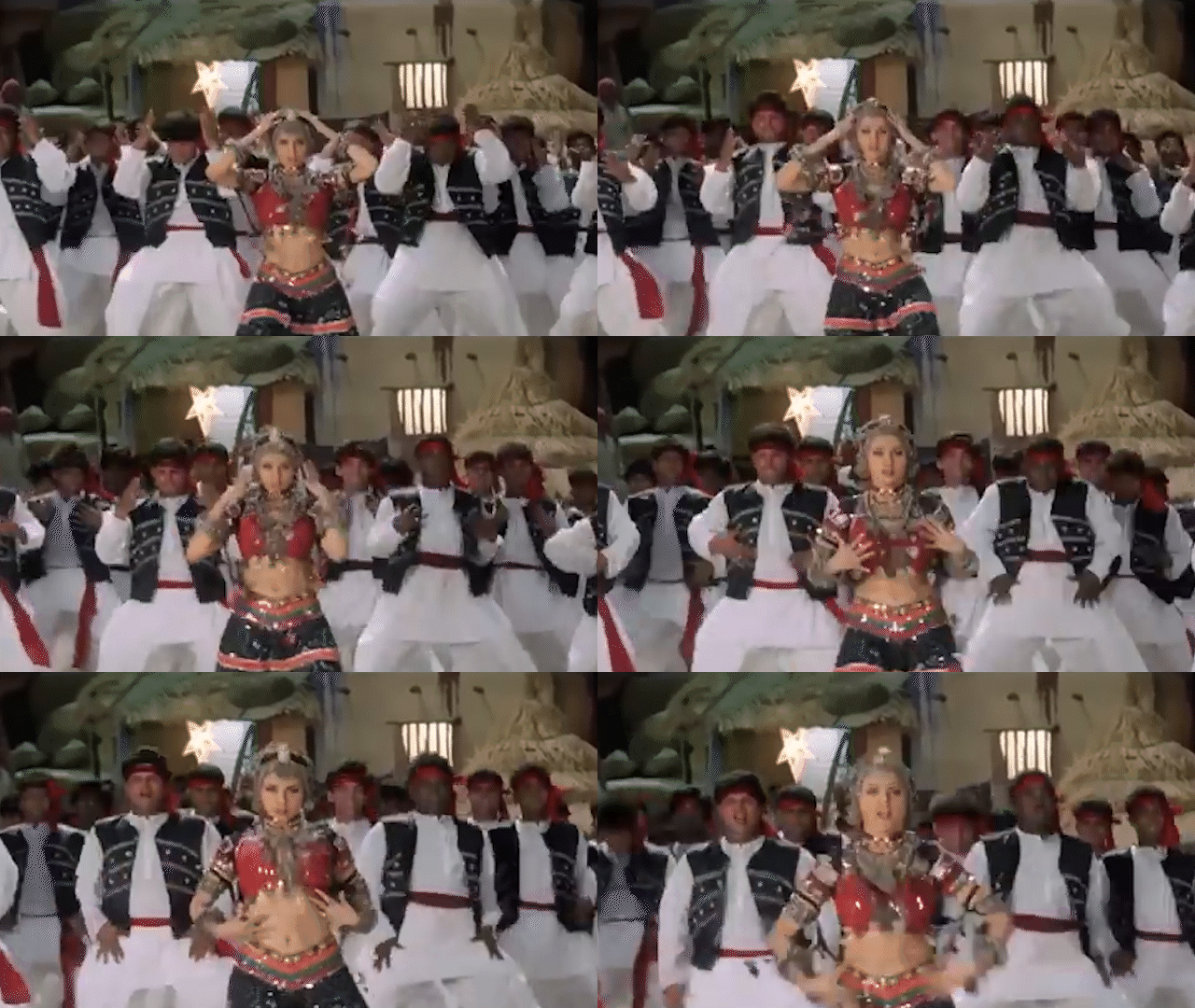
And then I turn to an interview where Rani Mukerji (widely called the queen of lip syncing) is asked about the challenge of lip syncing.
She laughs and says: “There is no challenge. Abhi gana laga, abhi lip sync karti hoon.” (Play the song, I will start lip syncing now)
It could be that easy. Alexa, play Aga Bhai, Halla Machaiyi Re.
Deepti Sreeram is a final year PhD student who has worked as a reporter and a features editor in a previous life. When not writing academics, she finds joy in writing personal essays. You can read her work here and follow her occasional reflections on Substack here.
Sources: YouTube/Ayngaran Music, YouTube/Music Remastered, YouTube/Shawan Al Mahmud, YouTube/YRF

 | A guest post by
|
Love it when someone enhances visual joy of a scene with their words. This post does that and more.
Beautifully written! Lal certainly had the advantage of being a better "Kaansen" if he doesn't know Carnatic (I am not too sure), hence better lipsync.
One thing I must mention that this article deserved a mention of great Dilip Saab and his song "Madhuban me Raadhika Nachi re", for this song, he had learnt how to play the sitar and played exactly how it was composed, just look at him when the piece comes, apart from performing a complex tarana to a tee! It was something like this I guess - Tanan tanan tanan tumtānā nā nā nā nā nā nādere nā nā nā nā nāyam tā re nā nā nā nā nānā tadāre tadāre tadāre dhūm nā tā nānī tā nā nī nānā nā nā...
Almost all the yesteryears actors understood poetry, classical music and words rooted to our culture (irrespective of their pedigrees). Today sadly when most of them think in english, have no idea of what is an essential DNA of an indian song, how could they lipsync or dance effectively to those songs! Pretty much like kids scream Donut when they see a vada!
Please keep writing!