
How Satyajit Ray never let us forget India’s real artists
and made an iconic film to make sure of it

1958. Satyajit Ray showed us what it really means to offer an ode to the performing arts in India in his film Jalsaghar. The Bengali language film punctuated the auteur director's award winning Apu Trilogy. It showed us the story of an old zamindar on the brink of bankruptcy and change. How feudal social structures made way for a new kind of bourgeoisie looking towards the future. And most importantly, the film provided a vibrant template for depicting Indian performing arts.
In Jalsaghar, Bishwambar Roy played by the inimitable Chhabi Biswas is clinging onto every last rupee in his coterie to preserve his palatial mansion. A zamindar meaning a landlord by profession, Bishwambar Roy’s greatest pleasure is putting on lavish Jalsas or evenings of music and dance in his Jalsaghar or music room. These performances are his pride and joy, they are also, in the film, used as a measure of his declining wealth and importance.
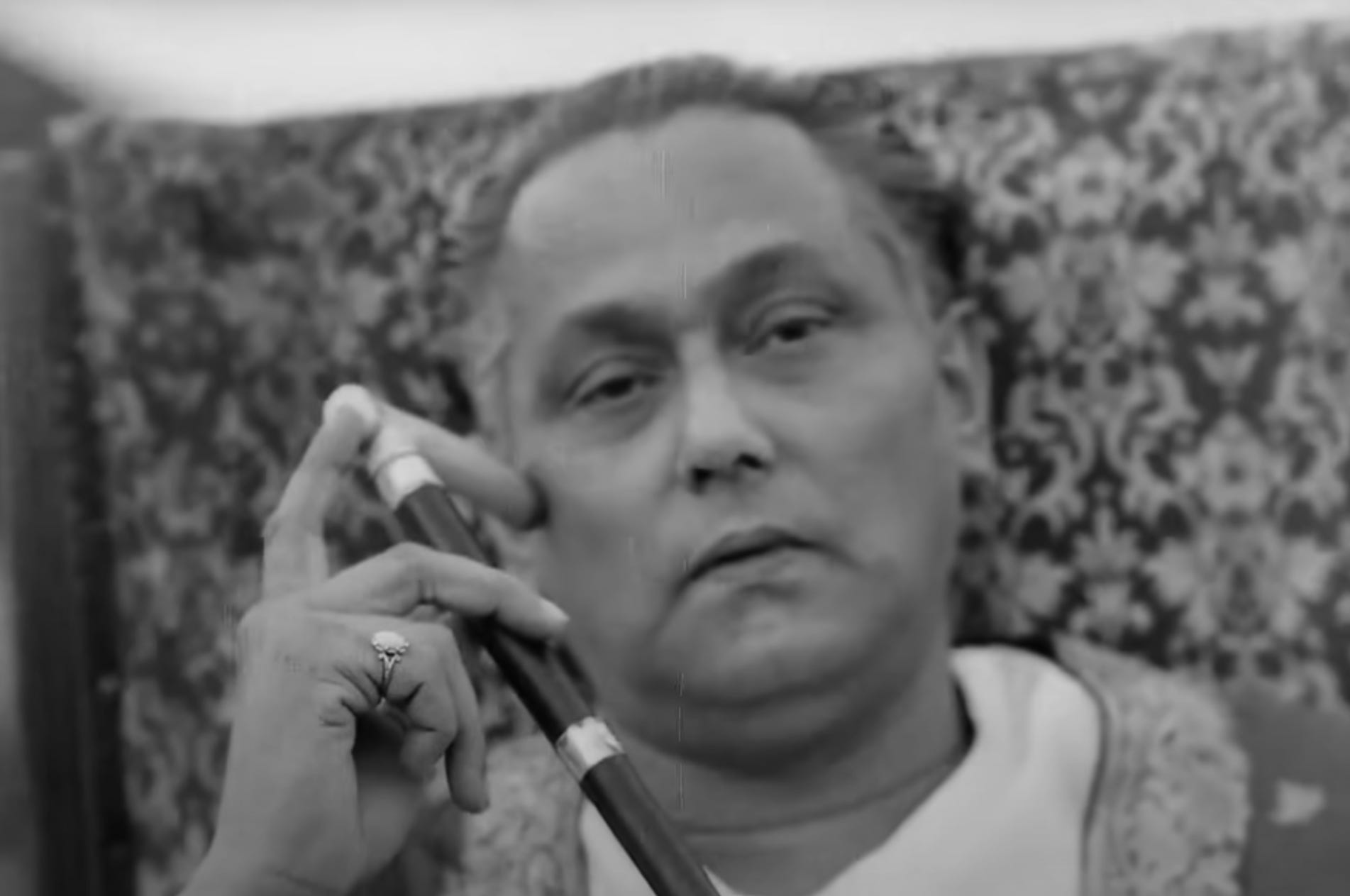
After a trip to her mother’s house, Bishwambar Roy’s wife and son are killed in a boating accident. Thus begins Roy’s descent into madness. Grief overtakes the declining zamindar and his last breath of revelry is a final jalsa performed by the most popular dancer of the time, Krishnabai played by Kathak maestro, Roshan Kumari.
Ray’s treatment of Jalsaghar reminds me of Orson Welles’ 1941 film Citizen Kane. In it, Charles Foster Kane, a publishing tycoon, dies suddenly, leaving behind his palatial estate named Xanadu. Citizen Kane, for most film students, is studied as a text for lighting and camera work. Welles’ camera guides us through his story with masterful compositions, playing with light and darkness; chiaroscuro. Jalsaghar does something similar in its treatment; however, it attains a sort of softer, more romantic, oriental touch. The music room itself in Bishwambar’s palace is packed with large decorative mirrors. The carpets look intricately crafted and the chandeliers, which become a motif in the film, are delicate yet have magnitude. A jalsa celebrates the finer things in life, and so, before a performance begins, the room is lit with candles, imported alcohol is poured into embellished decanters and the space is perfumed with attar. Guests and hosts alike wrap around their wrist a garland of flowers as they lean languorously onto ornate pillows. This softens the man who is our protagonist. It gives us an insight into his more delicate side, the side that eventually leads him to his decline. The two films treat their main protagonist with sympathy and pity. Watching the downfall of a great man is one thing, but watching them fall prey to their own selves is another.
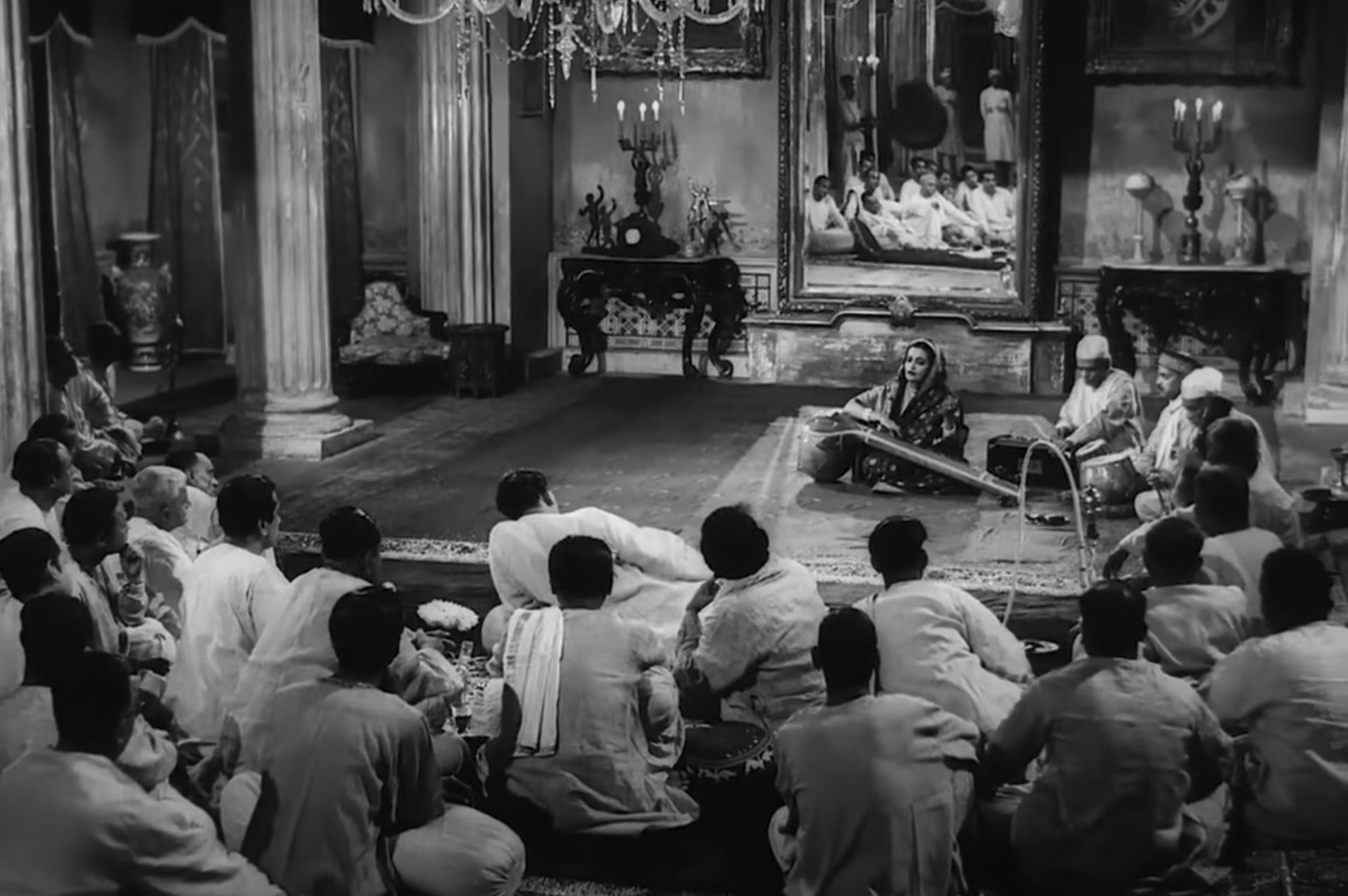
Music and dance in Indian cinema is at the centre of understanding the country’s film language. However, here. Ray treats it as a motif first and then as a catalyst for change. Bishwambar’s jalsas are a symbol of his wealth. When he calls the biggest names in music and dance, pours endless amounts of imported whiskey and lights up hundreds of candles, it is for us to gauge his wealth. After his final jalsa, when everyone has left and the same candles burn out, Bishwambar descends into a panic stricken frenzy initiated by a sudden realisation that his reign is coming to an end. He no longer has his family, nor his riches, nor his beloved music and dance.
A catalyst for his descent is his neighbour, Mohim. Mohim Ganguly has climbed the ranks through his sand business. He is, as the film tells us, the future bourgeoisie. Out with generational wealth, in with wealth earned from hard work. We watch him as he ascends to being Bishwambar’s equal, silently. At the beginning, he is treated by Bishwambar as a needy nobody who comes only to ask for help and money. After the death of Bishwambar’s wife and son, Mohim celebrates his own son’s poite or sacred thread ceremony. Bishwambar is alerted to this by the sound of a melodious shehnai coming from Mohim’s house. When asked who has come to play Bishwambar is told by his manager that it is Bande Ali, a well known musician. Not only is Mohim organising a jalsa at his house but he has also called one of the best. Mohim’s jalsa thus becomes a nail in the coffin of Bishwambar’s declining legacy.
Many film critics and Ray admirers have noted that apart from being so poetically told, Jalsaghar stands out for having documented some of the finest performing artists of the era. It had on-screen vocal legend Begum Akhtar and dance maestro Roshan Kumari. Ustad Vilayat Khan, one of the torchbearers for the sitar, did the background score and the shehnai that breaks Bishwambar’s heart was played by none other than Ustad Bismillah Khan. The 1950s was a time of disruptive change. It had only been a decade since independence. India as a new nation was still learning what its people needed, what they looked like to the world and most importantly, building a national identity.
Bearing the brunt of a national identity was India’s arts and performance traditions. Music and dance as a cultural legacy “profoundly affected the cultural revival that accompanied the process of nation building,” says ethnomusicologist Margaret Walker. The British’s policies and Victorian sensibilities did not align with the performance practices in India which often blurred the lines between sensuality, sexuality, gender and performance. The removal or disenfranchisement of the performers in the 19th century, especially the women, also aided the idea of India as a pure nation with an ancient, categorically Hindu, past. Courtesans and performing artists who greatly contributed to the arts in India, were forgotten. Jalsaghar is thus not simply an archive of a time gone by, it is also a rebellion of recognition.
By bringing performers like Roshan Kumari and Begum Akhtar onto screen, Ray put back into their hands their recognition. By making the arts central to the story and by getting the original artists to perform their traditional compositions on screen. Jalsaghar was able to create an impact beyond its 1 hour and 38 minutes of run time. There is a lot more to learn from Jalsaghar than just its storytelling.
Audio edited by Shashwat
Roshan Kumari’s dance - Source - Sandeep Dougal/YouTube
Begum Akhtar’s song - Source - Voice from the past/YouTube